
Swift Departures
Each of them is still an arrow that stabs me in the liver once a year--the day I realize they aren't there.
If you enjoy what you’re reading here and want to support us, why not subscribe? It’s free to all and you’ll get access to our weekly posts. It’s the best way to support us.
People are hypocrites. It's not necessarily a debilitating condition, especially when you're aware of it, but it's more or less always there to some degree. Fathers despise their sons for exactly the faults they caudle in themselves. Churchgoers call their pastors clods for sermons far more cogent than anything they could manage themselves. We are, as a species, shufflers of inscurities, skilled at the shell game of self-deception.
I became aware of a minor version of this sort of thing inside myself recently. The fact is, I like a lot of things about summer: the more relaxed pace, the tomatoes bulging red on the vine, the beach, the easy-to-remember recipe for a Negroni. But I don't like the weather. As far as I know, no place except for San Diego actually feels the way we think summer is going to feel. I grew up in a humid place. We spent the months between May and September hiding next to the central air duct. I now live in a less humid place--except during the summer. Every year, sometime in early June, there's a magical sunrise where the whole world seems to relax its shoulders for the first time since Christmas. Birds erupt out of the trees and into song. Cute little rabbits scurry from their holes and nibble a bite of clover. Then, in less than an hour, the sun breaks over the treeline and hits the world like a hot iron. Everything explodes into clouds of steam and, I confess, I start counting down the days till Halloween.
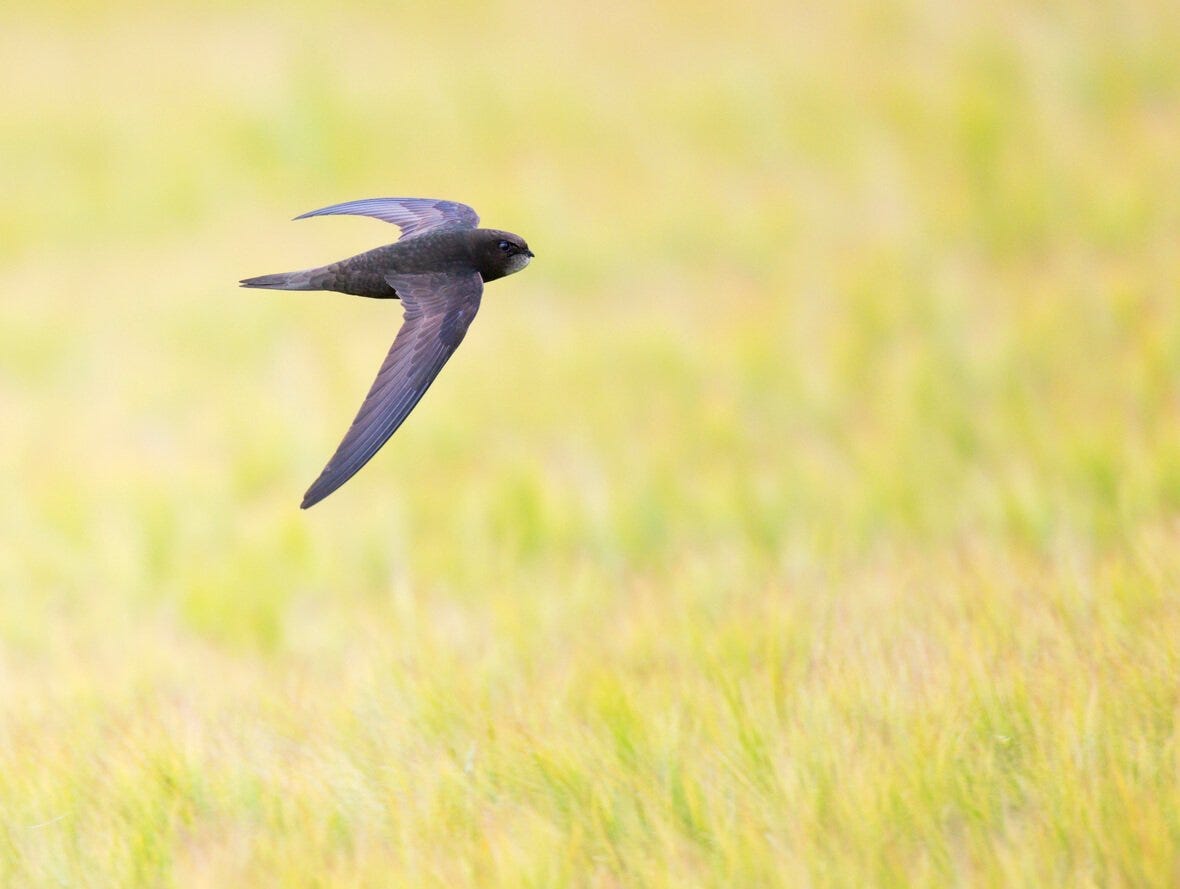
But the intensity of that feeling doesn't make me like certain things any less--certain things that are tied intrinsically and biologically to summer. One of these things is the Chimney Swift. On the whole, the Chimney Swift (Chaetura pelagica) is an ugly bird. People call them "the flying cigar," but a more clear-eyed assessment would have called them "flying dog-logs:" they are brown, long, vaguely fecal, and--most unsettling of all--can't perch upright. Evolved to live in our abandoned chimneys and other shaftlike spaces, they can only cling to vertical surfaces like a roach. Once, I stumbled on one of them clasped against the wall of our bulkhead entrance and actually recoiled in horror. But then it took off, flashing its half-moon, swallowish wings and fluting its chuckling song and, in spite of myself, I started to like the dang things, to look for them as a sort of sign of summer. As if summer was something I wanted, or wanted a sign of.
You Might Also Like:
From late May to mid-September, they nest and breed along the east coast, wintering, like aging baby boomers on pension, in South America. For all of their time here, especially at dawn and sunset, they coil and kettle in the skies, cackling and performing breakneck acrobatics, snatching insects out of the air. Invariably, I'm reminded of the last line of Keats' "Ode to Autumn," which at one point before kids I actually had memorized: "And gathering swallows twitter in the skies." Obviously, the swifts are not swallows. And obviously, they aren't around in autumn, but your brain doesn't ask permission when it forms these kinds of associations, and the line transfers a sort of rose-toned melancholy to them that I'm sucker enough to like. On good evenings, I'll lie on a cushion on our porch and watch them, and not mind so much that the dew point is eighty-eight degrees.
And then one day they're gone. You can never really be sure when that day will be and, if you're paying attention, you'll realize that it all happened gradually. The numbers diminish. The skies around the back half of August aren't quite as full, and you can even fancy that after a string of cooler days, big groups of them have moved on. But the slow trickle has nothing like the impact of the silence, like the shutting off of a background noise you didn't know you were hearing. All of a sudden, no sound is coming down at you from the ceiling of the world, apart from the occasional seagull's demented, chainsmoking bleat: a fitting herald of Boston winter if there ever was one.
It's that sense of departure, as much as anything else, that makes the swifts mean something to me. Flying memento moris in miniature, a wheeling part of the cosmic order that is no more capable of relating to me than I am of flapping my arms and migrating to the Caribbean, each of them is still an arrow that stabs me in the liver once a year--the day I realize they aren't there. I'm highly skeptical of the sort of logic that says we only value the absence of things. It’s not so much that I wish they were always there, or that I'm kicking myself for not spending more quality time birdwatching on the porch. Instead, I think the swifts are part of a larger family of melancholy objects, different for each of us but often overlapping, that scald us into remembering our own fugitiveness in the world. Stay humble, they seem to suggest in their awkward, ugly way. One day it'll be your turn to vanish, too.
Classical Roots is a free weekly newsletter—mostly about gardens. If you want to support the cause, the best way you can help us is to spread the word.
Also: Tell me what you think! Your comments are part of what makes this program worth doing and this newsletter worth writing. If you have thoughts, advice, questions, or enthusiasm, let me know! Others are waiting to join the conversation.
I've never wondered about chimney swifts. We've had them in our chimney since we moved in and only Mom can hear them. I always enjoy your original thoughts on any subject. Hey, think of their absence as the first sign of autumn.