
Intelligent Design
Aesthetics inform herbology

Classical Roots is a free weekly newsletter. If you want to support the cause, the best way you can help us is to spread the word.
A friend of mine, a professor of New Testament Studies, often quips that “aesthetics informs theology.” He says this frequently insistently enough that I associate the idea with him closely—an idea that, though it is welcome to my poet and writer’s mind, challenges many of the tacit assumptions left behind as a sort of theological effluvium by a very low-church Presbyterian upbringing. Gaither Chapel, the river-stone church in Montreat, NC, where I grew up worshipping, and which has since been renamed Graham Chapel after the late Billy Graham, is a place of entrancing beauty, with its exposed beams of Wormy Chestnut, its symmetrical stained-glass windows, and the glint of lichen catching candlelight in a thousand variations during night services.
Though the worship we held there was very low church indeed, with nary a word about the church calendar and very little language repeated except for the Lord’s Prayer and Apostles’ Creed, the building itself indelibly informed my concepts of beauty, sacredness, orderliness, and the grace and simplicity of sincere, unassuming faith. It was the most natural thing in the world for me to associate church with a kind of elevated simplicity and austere loveliness that has undeniably profited my faith. The architecture, the aesthetics, informed the theology.
It’s a principle that applies to more than one area of life. Whether we like it or not, the aesthetics of an object or place shapes our interactions with it on fundamental levels. It should not have surprised me, then, when, earlier this year, I found my gardener’s world shaken by a watering can.
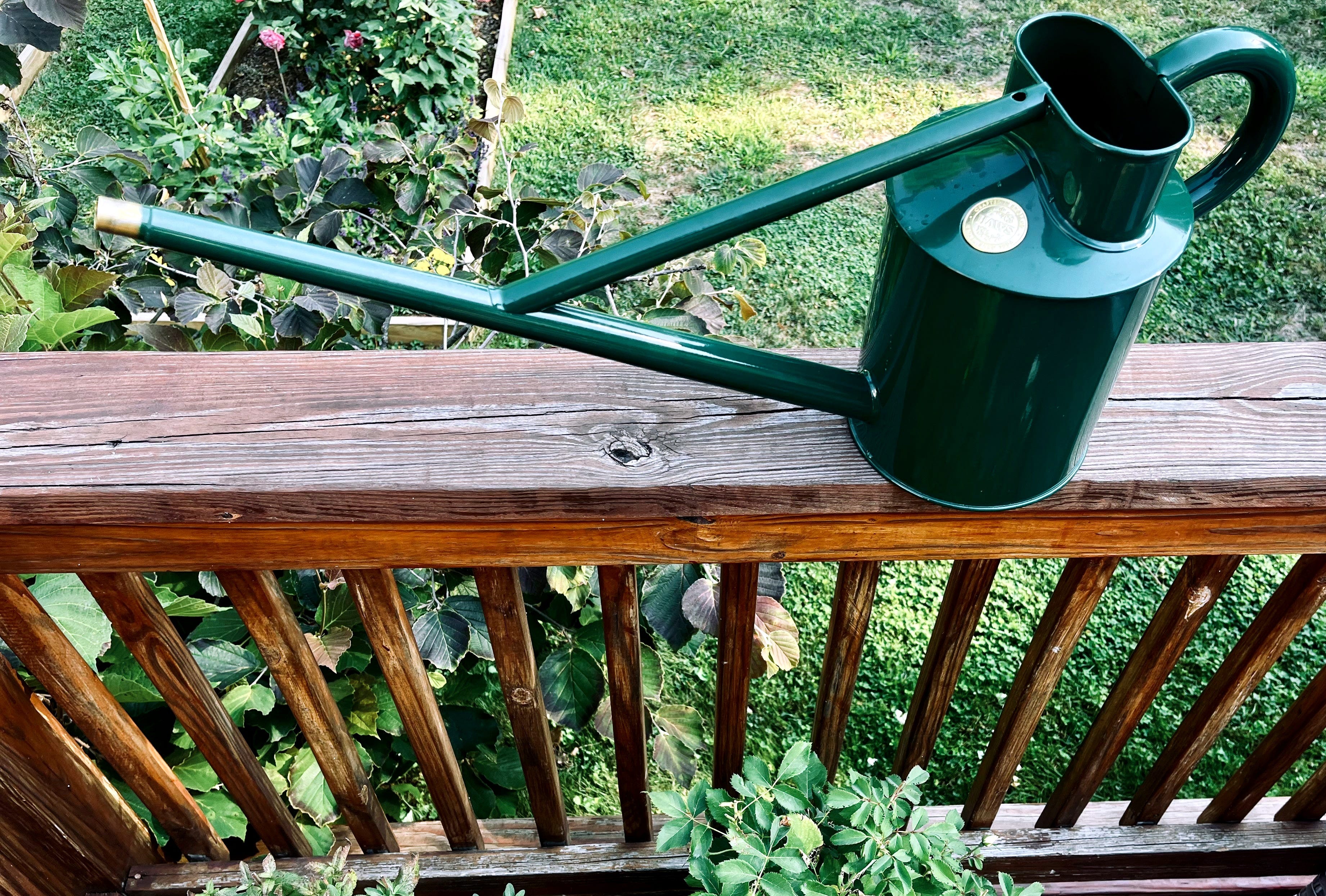
But not just any watering can. This was a Haws Warley Fall powdered steel two-gallon watering can in green. Presented to me by the parents of one of my former Prefects, it was a gift I couldn’t fully appreciate at first. It is, in fact, a masterpiece of design that has since informed almost all the gardening I do; an object of heritage, symmetry, and undeniable grace. I feel almost foolish extolling it with language this elevated but, as the kids say, if you know, you know. And once you have used a Haws watering can, any other version starts to look and feel like trash.
You Might Also Like:
Anyone who has used a watering can extensively has had to wrestle with two problems. First, that it is sometimes hard to make the flow gentle enough not to smash up, or even uproot, delicate seedlings and houseplants, and conversely, that it is often difficult to make the water flow fast enough to quickly fill large pots or to reach plants in the back row of a border. These twin problems would seem to imply a design decision: you either have to make a slow and gentle watering can or a fast and furious one. Somehow, Haws has managed to create a single object that does both of these things well. The brass rose nozzle attachment drops water delicately as summer rain, while the unadorned spigot jets water accurately at a prodigious rate. And, as if this weren’t enough, a second attachment aims water at a forty-five-degree angle downward—a perfect application for house plants and hangers. Its powdered steel is pleasant to the touch, and the handles occur just where your hands naturally fall. It is, in short, a thing so natural to use that it becomes a thoughtless extension of your body, an agent of your mind.
Objects like this exist in all hobbies and industries. There are perfect fountain pens, perfect dive watches, perfect shoe horns, perfect shooting jackets, perfect tweezers. To the uninitiated, the price point of these most elevated versions can seem extreme and even offensive. But—and I am aware I am saying this as someone who received the thing as a gift—I would pay double to replace this object if I lost it. And not just because it is pleasing in itself, which it is, and not only because it was a princely gift from a generous friend, which is also true. I couldn’t be without it now because it makes me want to take care of things, to garden, to be a better gardener. The excellence of its craftsmanship challenges me to greater excellence as a laborer and craftsman.
It’s an object that almost entirely removes the frictions that make the task of watering difficult, allowing it to become a form of meditation. In the first chapter of her lovely book The Liturgy of the Ordinary, Tish Harrison Warren observes that, in every small act of orderliness, even the making of our beds, we are participating in the same divine act that gave the world order in the first place. Hyperbolic as it might sound, watering plants taps very much into that generative, orderly spirit. My Sunday ritual of grabbing my gurgling watering can, fitting it with the right nozzle, and going from room to room in my house, watering each plant and, by consequence, checking on its health, on its needs, and its function in the larger aesthetic scheme of the house, doesn’t feel like the accomplishment of a chore anymore, but the return of a festive ritual, something borderline sacrimental, at the very least liturgical.
And I know I am not the only person who feels this way. I’ve heard stories from suicidally-minded and depressed people who get themselves out of bed every morning partly because they know they need to nurture plants under their care—the plants serve as reminders of the larger systems of love and relationality they occupy; a reminder that there are living things and people who depend on them. It seems fitting to carry something beautiful, something well-crafted for the task and sturdy and pleasant to hold, into that ritual of nourishment.
I’ve been given several opportunities to speak publicly about my work with Classical Roots, to answer questions about the initiative and its benefits to the human person. At those moments, I often find myself coming back to the observation that, when we care for the earth, we find ourselves mysteriously cared for. The gift of this lovely and intelligently designed object was, of course, a way for a friend to care for me; it has also become a way for me to care for the landscape and students under my temporary stewardship.
If you enjoy what you’re reading here and want to support us, why not subscribe? It’s free to all and you’ll get access to our weekly posts, as well as a weekly subscriber-exclusive chat where we brag about our gardens and beg for advice. It’s the best way to support us.
Want to support the program and look great, too? Check out our Squadlocker store for exclusive merch. All proceeds go to fund future Classical Roots projects!