
Bite the Apple
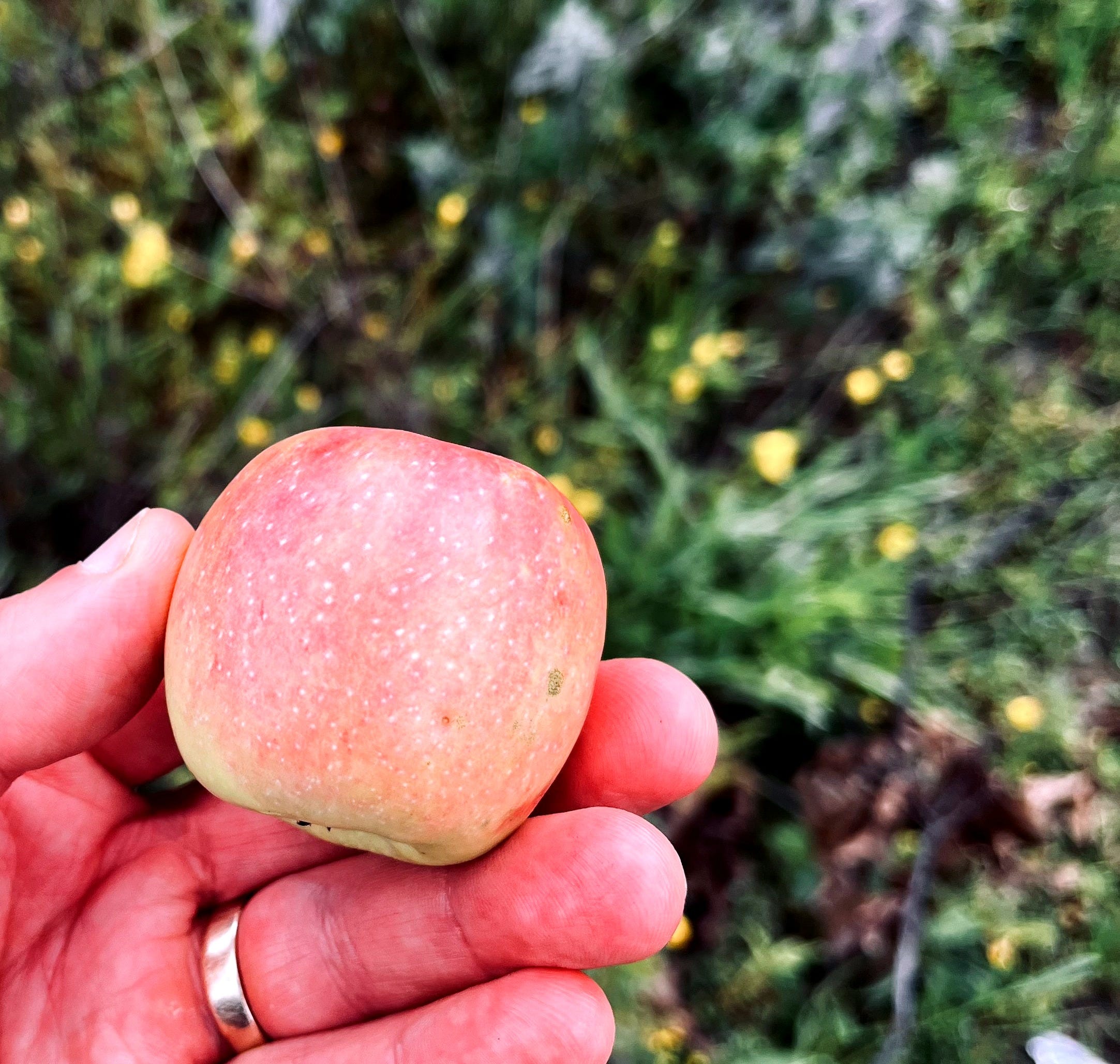
Our orchard's first fruit
Classical Roots is a free weekly newsletter. If you want to support the cause, the best way you can help us is to spread the word.
One of my favorite poets is the seventeenth-century haiku master, Matsuo Bashō. There’s a lot to be said about Bashō as a writer, a humanist, a proto-wanderer of Zen Buddhism, and as a rejector of the political rat race in favor of the contemplative life. The collections of haiku he left behind spawned a whole school of poetry, not to mention innumerable imitators. But sprinkled among his many poems and journey narratives are a few pieces of direct writing advice that have survived the centuries. I remember paging through one of these little essays years ago and stumbling across a line that confused me: “The writing of a poem should be like the biting of an apple.”
It was not an idea that yielded itself immediately to my understanding. What did he mean? That writing should be delicious? That it should be crisp, or intense? The Japanese didn’t associate apples with original sin, since they didn’t have a concept of it, so there was no biblical reference in Bashō’s quip. His meaning didn’t dawn on me until I actually went to my kitchen and ate an apple.
I realized, at that moment, that it’s an impossible thing to do slowly. Unless the apple is borderline rotten, you can’t gradually sink your teeth into it. No, you have to bite down and rip out a chunk wholesale. Now the meaning became clear: you have to prepare for writing, then attack it. It’s a lifelong pursuit and each individual project involves sketch work and contemplation. But, when it actually comes to putting the thing into words, it should be done like the biting of an apple: ripped out all at once. Otherwise, whatever you create won’t be a unified whole.
I thought about Bashō’s advice the other day when I made a delightful discovery: the first apple in CCA’s orchard. The Senior Class of 2023 helped us plant these semi-dwarf trees, part of a twenty-seven-tree scheme that includes apples, pears, and plums. We don’t expect big yields from them for a few years yet, but this first fruit—a Pink Lady apple—was a marker of how far things have already progressed while we were tending to other things.
You Might Also Like:
The orchard had originally been a long-term dream of mine, a distant part of the ten-year plan I drew up the year that Classical Roots was first created. But, after the success of our veggie garden in 2021, the administration asked me to think bigger. We had a big graduating class that could spend part of the end of the year working. We had a big swath of grass out in front of the school, and we had big support for the program. So, with a little modest funding in our pockets and the first frost lying on the fields, we began to measure, mark, adjust, measure, and mark again. It was a meticulous process that started with a lot of math and ended with a lot of instinct, the goal of which was to create clean lines of orchard trees in a nine-by-three row. We were, of course, eventually stopped by the snow but, come early spring—while it was still snowing, in fact—the trees arrived from California. We heeled them into a bed in the veggie garden, where they slept at a dormant angle for a month or so before they began, in April, to leaf tentatively out. Then, grabbing our gloves and shovels, we bit the apple.
Every tree in the orchard went into the ground in a matter of about two weeks. Though we hadn’t realized it before, the grassy field into which we were planting them was created with slag from the digging of our building’s foundation. It was therefore an eclectic mixture of soil types and sprent with stones. But every patch of it had two things in common: sharp drainage and good nutrition, which we augmented with organic compost. It was strange, after the work was done, to see the small trees looking like no more than a few rows of twigs shoved into the grass.
Now, years later, I was holding the harvest in my hand. I texted a picture of it to a few of our alumni, one of whom told me that the picture made them cry. What is Classical Roots? It’s hard to explain to people, but very easy to show to them. Among other things, it’s trying to be a cure for the false dualism that plagued the school experience for so many of us: the implicit assumption that we are ghosts in machines, and that it suffices to keep us sitting in fluorescent-lit rooms, consuming information. I wasn’t thinking about this when I named the program, but it’s a thing that’s at war, so to speak, with rootlessness. And, though the real harvest I’m after has to do with students, not fruit, I was happy to have this tangible proof that, through the seasons, things are maturing, progressing, ripening.
I ate the little apple standing out there in the sun. It tasted good.
If you enjoy what you’re reading here and want to support us, why not subscribe? It’s free to all and you’ll get access to our weekly posts, as well as a weekly subscriber-exclusive chat where we brag about our gardens and beg for advice. It’s the best way to support us.
Also: Tell me what you think! Your comments are part of what makes this program worth doing and this newsletter worth writing. If you have thoughts, advice, questions, or enthusiasm, let me know! Others are waiting to join the conversation.